A poorly tuned windsurf rig feels heavy, unstable, and seems to fight your every move. It's a frustrating experience that drains your energy and kills the…
A poorly tuned windsurf rig feels heavy, unstable, and seems to fight your every move. It's a frustrating experience that drains your energy and kills the fun. In stark contrast, a perfectly tuned rig is a revelation—it feels light, balanced, and responsive, becoming a seamless extension of your body. Suddenly, you're not fighting your gear; you're flying with it. That's the feeling we're chasing. This guide will demystify the complex world of sail tuning, providing a systematic approach for any windsurfer to unlock their equipment's true potential and maximize performance, control, and enjoyment on the water.
To effectively tune your sail, you first need to understand its basic anatomy and the aerodynamic forces at play. This knowledge is the essential foundation upon which all effective tuning is built. It's the difference between random guesswork and a predictable science, allowing you to make intentional adjustments that yield specific results.
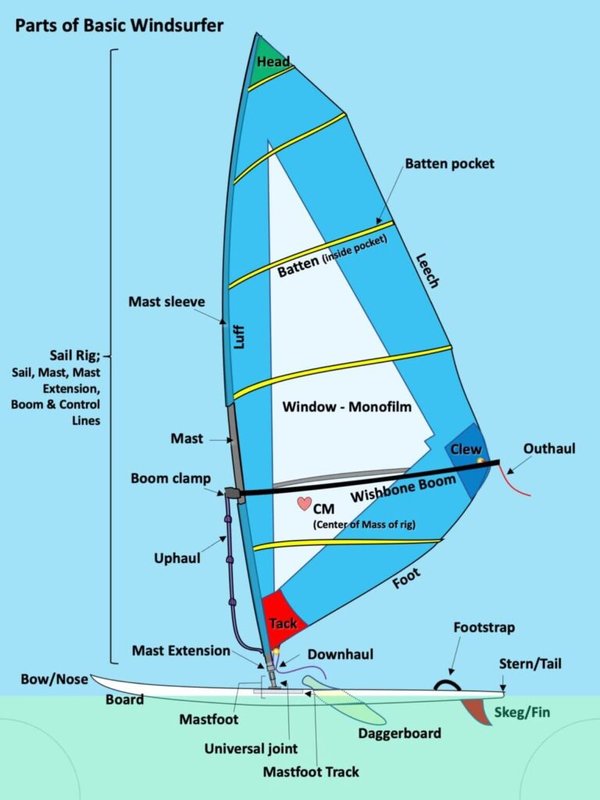
Every windsurf sail is composed of three corners and three sides, each with a specific name and function.
The feeling of a sail—its power, stability, and speed—is governed by a few core aerodynamic principles.
These aerodynamic shapes are not created by the sail alone; they are fundamentally defined by the mast that gives the sail its structure.
The mast is the single most important—and often the most misunderstood—component of your entire rig. It is not just a pole to hold the sail up; it is the rig's dynamic suspension system. The mast's specific flex characteristics dictate how the sail loads up with power, releases pressure in gusts, and ultimately how it feels in your hands.
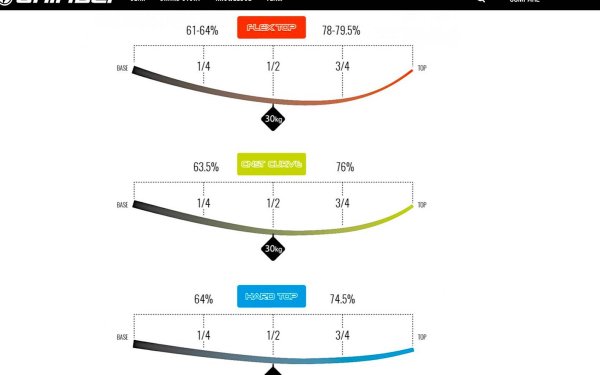
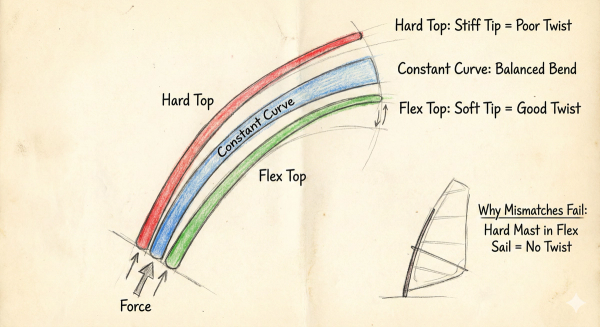
A mast's performance is defined by its specific bend curve, stiffness (IMCS), and reflex (the speed at which it returns to its shape after flexing). Sail designers create a sail around a specific mast bend curve (e.g., Constant Curve, Flex Top, Hard Top). Matching your mast's bend curve to the sail designer's intent is absolutely critical for the sail to achieve its intended three-dimensional shape.
Using a mast with the wrong bend curve for your sail creates fundamental aerodynamic flaws that no amount of tuning can fix. The sail's draft will be in the wrong place, the leech won't twist correctly, and the entire rig will feel dull, twitchy, or maddeningly unpredictable. All other tuning efforts will be ineffective. It is far better to use a lower-percentage carbon mast with the correct bend curve than a 100% carbon mast with the wrong one.
With the correct foundational components in place, you can now begin to tune the primary controls with confidence.
While many small adjustments are possible, windsurf sail tuning fundamentally revolves around three primary controls: Downhaul, Outhaul, and Boom Height. Mastering the interplay between these three settings is the key to adapting your rig to feel perfect in any condition.
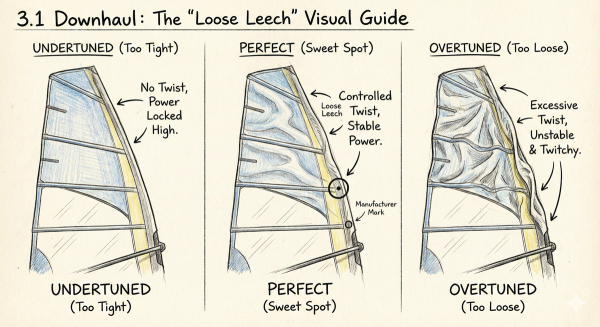
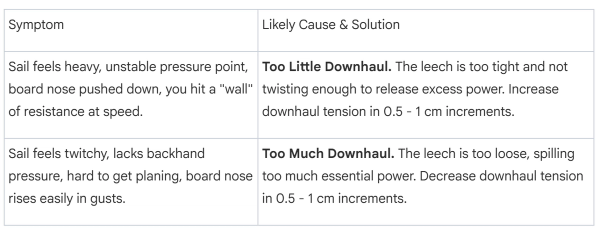
The downhaul is the most important tuning setting. It applies tension to the luff of the sail, controlling the mast's bend. This, in turn, dictates the sail's leech twist and the position of its draft.
Setting Your Extension: Before applying tension, ensure your mast extension is set correctly. A good starting point is: (Recommended Luff Length) - (Mast Length) = Extension Setting. It's often wise to leave an extra 1-2cm of space so the pulleys don't touch (block-to-block) when fully downhauled.
Pro Tip for Camber Sails: If you are using a sail with camber inducers (cams), the tuning sequence is slightly different. Usually, you need to downhaul the sail halfway, pop the cams onto the mast, and then apply final downhaul tension. Cam sails also generally require higher initial batten tension to lock in the profile against the mast.
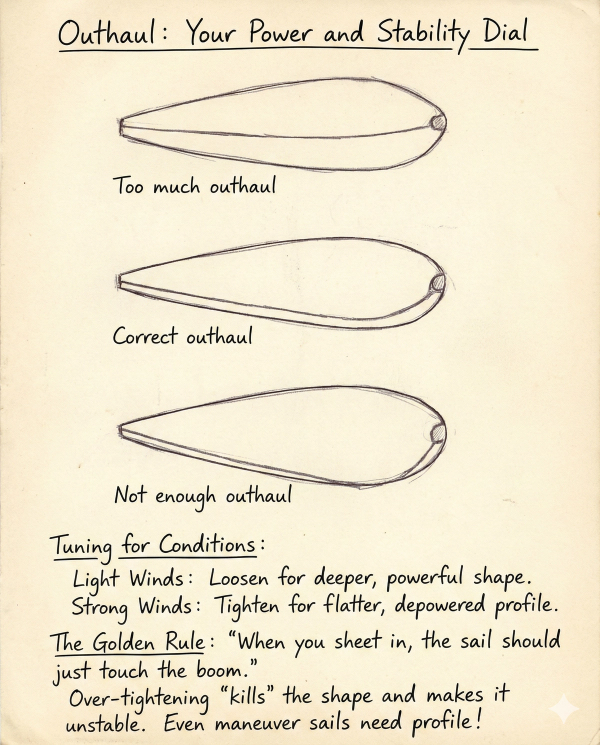
The outhaul controls the sail's depth (draft) along the boom. It is your primary tool for adjusting the raw power and stability of the sail.
Boom height is a personal setting that adjusts your leverage over the rig and board. The correct height depends on your body, the conditions, and your performance goals. The general range is between your lower chest and your mouth.
With the primary controls set, you can now move on to the more nuanced adjustments that will take your rig's performance from great to perfect.
Once the "Big Three" are correctly set for the conditions, the final percentage of performance and feel is unlocked through finer adjustments to the battens, harness lines, and mast track.
The purpose of battens is to support the sail's profile and eliminate parasitic flutter, but the most common error I see is over-tensioning, which locks up the profile and makes a sail feel stiff and dead. A properly tuned sail needs to "breathe" and flex with the wind.
Your harness lines are the direct interface between your body and the rig's power.
The mast track position fine-tunes the board's trim, controlling how the nose rides on the water.
With all components now tuned in harmony, the final step is to have a simple framework for applying these principles to real-world conditions on the water.
Remember that tuning is a dynamic process, not a one-time setup. The best sailors are constantly feeling their gear and making small adjustments. This quick-reference guide will help you diagnose common issues and adjust your settings on the fly.
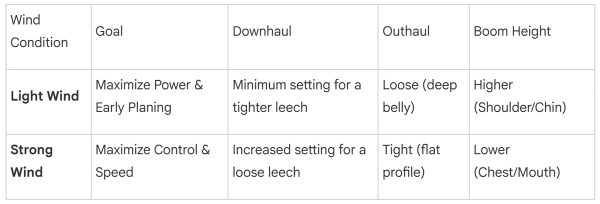
Use this checklist at the beach to quickly solve common performance problems.
Think of your rig not as something you set on the beach, but as something you feel on the water. Tuning is an ongoing conversation with your equipment, and this guide provides the language for that conversation.
Proper sail tuning is a transformative skill that elevates your windsurfing from a physical struggle to an effortless dance with the wind. It is a continuous process of learning to listen to the feedback your equipment provides and making small, incremental adjustments in response. Use this guide as your starting point, but don't be afraid to experiment with these settings on the water. Trust your feelings, make a change, and experience the pure thrill of a perfectly tuned rig flying across the water.
Now get out there and have fun!